The problem
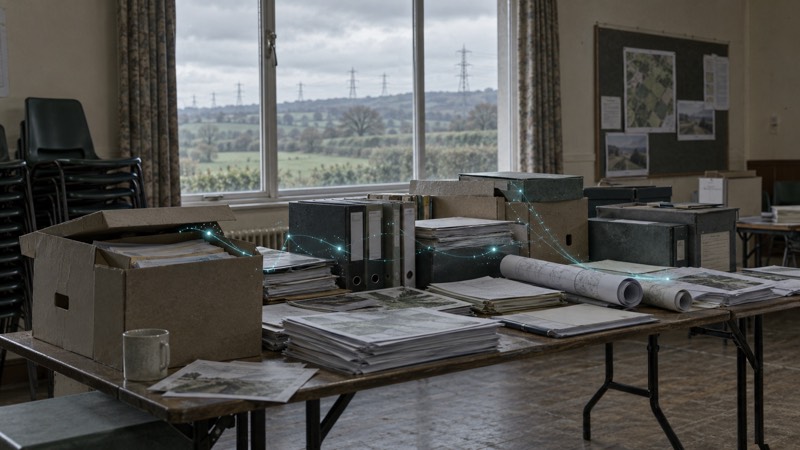
A Planning Inspectorate examination produces an enormous paper trail. Applicant submissions, technical appendices, public responses, hearing documents and supporting evidence pile up across thousands of pages, and the volume only grows as the process runs. For a campaign group — often working with limited time and people — the danger is simple and serious: the one document that matters gets missed because nobody could read everything.
The group behind the response to the Norwich to Tilbury proposal had exactly that problem. They were not short of evidence; they were short of a way to work with it. To respond effectively they needed to find, cross-reference and stand behind specific points buried across a huge, growing library of planning material.
The constraints
This is high-stakes, evidence-led work, and that shaped every decision.
- Everything has to trace to a real source. A planning response that quotes a document that does not exist, or misstates what a submission actually said, is worse than useless — it undermines the group's credibility in front of the Inspectorate. Nothing the system surfaces can be invented; it has to point back to the actual page it came from.
- The volume is the whole challenge. Standard search struggles with this much material in this many formats, and a person reading it end to end is not realistic. The work needed deep analysis across the full corpus, not keyword matching over a folder.
- The users are not technologists. The people who need answers are campaigners and subject experts, not engineers. The way in had to be a plain question, not a query language.
What we built
We aggregated the Planning Inspectorate materials, the public submissions and the supporting evidence into a single, database-driven custom workflow — then built an interface on top of it for AI-assisted querying, analysis and document retrieval.
In practice, the group can ask a question in plain language and get back the relevant passages, the analysis that ties them together, and the source documents behind them. Where standard tools would return a list of files to wade through, this returns the thread: what the material actually says on a given point, and where to find it. The deep data analysis runs across the whole body of evidence at once, so a point raised in one submission can be connected to the technical appendix three hundred pages away that speaks to it.
Why it's built this way
Grounding everything in the real source material is the core engineering decision, and it is there for the same reason a court of evidence exists: a claim is only as good as what it traces back to. By building the workflow so that every answer carries its source, the group gets speed without giving up defensibility — they can move fast through the volume and still stand behind every point in front of the Inspectorate.
A custom workflow, rather than an off-the-shelf search tool, is what makes that possible. Planning evidence has structure and context that generic tools do not understand, and the people using it needed a way in that matched how they actually work — asking questions, following threads, checking sources. We built around that, not around the technology.
The outcome
The difference it has made is best put by the people doing the work.
“Lumitec gave us a way to work with a huge volume of planning material without losing the thread.”
— Rosie, Campaign Lead
The system is in use as the examination continues, and the shape of the value is clear: a small group can now work across a body of planning material that would overwhelm a team many times its size, and respond on the strength of the evidence rather than the limits of the reading time available.
Where this goes next
The same pattern — ground a model in a large, messy body of source material, keep every answer traceable, and give non-technical people a plain way in — applies well beyond planning. Any group facing a document-heavy review under time pressure, from regulatory responses to due diligence to large public consultations, has a version of this problem.
If that is you, the place to start is a free, no-obligation AI Readiness Diagnostic. We learn how you work, map where AI would genuinely help, and hand you a statement of work, a wireframe and a clear ROI case you keep — whether or not we ever build it.
“Lumitec gave us a way to work with a huge volume of planning material without losing the thread.”
— Rosie, Campaign Lead